Headphone Information & Terminology
Do you have some questions about headphones? The article below may shed some light... (by Bill Keyser)Headphones have been around a while, but they originally were only seen in the recording studio or in the home! Now you see them everywhere these days! First walkmans, then discmans, now MP3s and iPods, Computers at work and on the road, and even portable DVD players! As the price of portable electronics has come down, more and more people are re-discovering the detailed sound quality headphones can offer. As the owner of a specialty CD store for many years, I wish I could have had a dollar for the number of times I heard a positive comment about their listening experience from someone finishing a session at one of our CD listening stations. I know I still can be amazed at the detail I hear through headphones that eluded me when listening with standard speakers. It is not our goal to sell headphones solely to audiophiles, but rather to introduce the rest of you to the concept of enjoying your music through affordable higher quality headphones.
Headphones are the least expensive way to listen to high quality music reproduction from your musical sound source. You would probably have to spend five to six times as much money on speakers to get close to the equivalent quality of sound you hear through headphones. Unfortunately though, most headphones sold these days are sold in sealed containers at department stores for the cost equivalent of one or two CD's. Or even worse, you are listening to the headphones they gave away with your portable player! Frankly, most of those headphones are lacking in sound quality! A few years ago Stereo Review's Ken Pohlmann wrote in an article about portable CD players, "The headphones supplied with CD portables vary widely, and their sound quality is almost always inferior to the signal quality available at the headphone jack"! And don't get us started about the cheap headphones many people have lying on a shelf collecting dust! If you had good headphones, you might be torn between listening to them rather than the tinny sounding speakers placed awkwardly in an out of the way corner.
We have sold headphones off and on since 1988. In our quest to become a "Quality" headphone specialist, we have spent much time over the past decade researching and comparing headphones for sound quality, comfort, and price. In our research, we have found Grado and the higher end Sennheiser headphones are consistently highly rated for sound quality by the audio experts. And more recently, we've been reviewing and liking some AKG headphones, a long established headphone manufacturer that used to aim primarily at musicians and recording engineers. Denon is catching our ears as well. Our initial goal here is to introduce the masses to high quality music reproduction at budget prices. And what better way to save money than to buy good but affordable headphones rather than good, but expensive speakers. We are always open to reviewing headphones from different manufacturers, but we do urge you to pay Grado some attention. Grado Labs is a small audiophile company dedicated to better sound quality at affordable prices. Though not winning any awards for styling, Grado's price/performance level is unequaled!
Don't Worry Too Much About Specifications: Frequency response specifications listed on most headphone packaging are only helpful for weeding out the cheapest of headphones (under $20). True sound quality comes from the headphones producing the most accurate music reproduction, which is not necessarily from headphones capable of reproducing sounds way above and below the range of human hearing. We have personally heard headphones with a frequency response from 20-20,000 Hz with far better music reproduction quality than a pair of headphones with a 10-30,000 Hz frequency response! Impedance and sound pressure levels matter a bit more depending on what source you are using to drive the headphones. Higher end home headphones, including many Sennheisers, usually need more power to drive them, so hooking them up to a portable CD player just won't do. Grado's, Portables, and IEM's however, sound great connected to most portable players, a standard headphone jack, or a headphone amp.
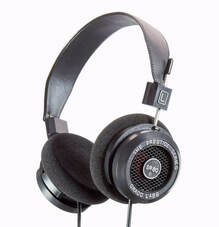
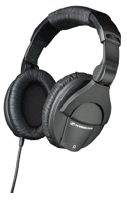
Circumaural vs. Supra-aural. Circumaural headphones have earcups which totally surround the ear and can be more comfortable than supra-aural headphones which sit directly on the ear. Weight and earpad materials can vary the comfort level. Many of the Sennheiser's and AKG's we review are circumaural and very comfortable. Grado headphones are supra-aural which has been the source of some criticism for their comfort level, (it's also part of the secret behind their great sound quality). I have found however that once the headphones are broken in, they become more comfortable. Also the Grado's are light weight, and since the headband is a sturdy leather or vinyl covered metal band, they can be bent to conform to your head (try that with the plastic cheapies).
Open headphones as opposed to closed or sealed headphones. Open headphones are not always the type that sit on your ears, they sometimes are full sized headphones with some sort of opening on the sides to allow the sound to resonate better, (many of the Sennheiser's and AKG's we recommend are this type). Closed designs block out more outside sounds, but sound quality is generally lacking (sounds like you are in a tin can). Unless you require outside sounds to be blocked out such as a musician in a recording studio, or will be listening in an environment where sound leakage will be a problem, we usually recommend the open design. A majority of the headphones we sell, (except the Noise Reduction Headphones), are of the open design. We are now doing some reviewing of closed headphones and are beginning to recommend a few models since many of you have asked!
Portable Headphones. I have purchased a few portable CD players and mp3 players in the last 20 years,
and I am continually amazed at the marvel of such neat little machines at affordable prices.
One thing that always disappoints though is the cheapie headphones or earbuds that come with such great
portable players! In order to keep costs down, virtually all of the companies have shortchanged
us with inexpensive headphones or buds that barely do their players justice. While we've had
some customers who prefer to connect a Grado SR60 or SR80 to their portables, to be fair, the Grado's
are actually mid-sized headphones. Not necessarily portable. True portable headphones are a bit smaller.
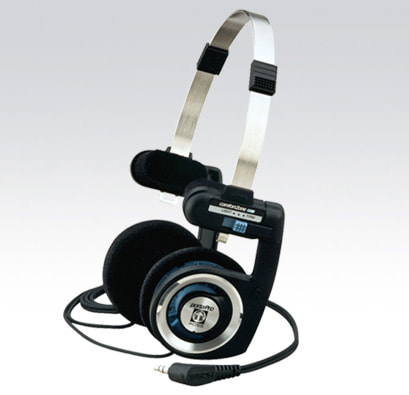
Sometimes collapsible. But unlike earbuds, portable headphones can create a large, full sized headphone
sound. Over the years we've been totally pleased with the Koss PortaPro, (not to be confused with the
lesser quality SportaPro). We've also been liking the Sennheiser PX100.
A couple of subcategories of portables are the "StreetStyle" headband, (behind the neck rather than on top of the head), and the "Ear Clip," (no headband, just clips to hold the transducer to the ear). Our favorite Streetstyle is the iGrado and our favorite earclip is the Koss KSC75.
Wireless headphones. Our emphasis with headphones has been "sound quality". We have auditioned quite a few wireless headphones, but they have a long way to go to catchup to corded headphones in the sound quality area and we are rarely impressed! And reception quality.... don't get us started! Most are bad! FYI, RF wireless headphones, (Radio Frequency), can sound good at some locations, and bad at others. Depends on what radio waves, electronics, or microwaves that may be around your listening location. So what works fine for one person at their house, may not work for you at yours? Frustrating!!! We do realize though many of you have a need for wireless headphones. Though we prefer a good headphone with an extension cord, if you investigate our site, you may find a review and recommendation for a wireless alternative, (we are especially impressed with the transmission quality of the xDream by FreeSystems... uses an infrared signal transmitting digital information!).
Noise Reduction Headphones. Sometime in the early 90's, ANR headphones began to be marketed primarily to airplane travelers. ANR refers to “Active Noise Reduction,” (as opposed to Passive Noise Reduction which is just blocking sound with a bulky, closed headphone, or use of earplugs in the ear canal). If you’re in an environment with a steady, low droning sound, (like an airplane engine), ANR headphones can be helpful because they produce an opposite sound wave to the ear which in effect, lessens the loudness of the offending droning noise. The result, the offending noise is reduced and you now have the means to listen to music or movies through headphones at a normal volume, (FYI, turning up volume in headphones to drown outside sounds is not good for the ears).
Some points about ANR headphones to remember:
-- Random noises are "NOT" reduced! Talking, banging, babies crying, etc..... not reduced by the ANR circuitry.
-- Sometimes erroneously called "Noise Cancellation" headphones.... they reduce one offending noise, not cancel!
-- $300 ANR headphones, even from self boastful famous audio manufacturers, do not sound as good to an audiophile's ears as does a $69 Grado SR60. Besides being closed which affects sound quality, the ANR circuitry introduces some hiss.
-- If you travel a lot, by all means, spend some money on some good ANR headphones. But if you only travel occasionally, opt for the less expensive ones for traveling and buy some regular headphones for all other uses.
-- You may want to consider an IEM, as they can passively block outside noises.
IEM's, In-Ear-Monitors, Canal Phones... In-Ears are a tricky product to recommend. So much depends on the fit in the ear for both sound quality reasons and for noise blockage reasons. And everyone's ears are different, so what works for one person, may not work well for another! Plus, some people can't stand sticking the things deep into the ear canal, while others seem to get used to it, and love the intimacy of the sound. Etymotic and Shure kind of led the way in this category. But given the popularity of the iPod, (and other portable players), and the not-so-good earbuds that come with them, IEM's are getting more and more popular and many companies are jumping in with me-too products. Unfortunately, the better ones are quite expensive, ($200 and up). In the under $100 category, we've found a couple of Denon's we like, (whereas many in the lower price ranges are lacking in detail or bass).
Due to the portability factor and the noise blocking factor, I've enjoyed some in-ears for several years now. They sound better to me than earbuds which I don't find fit my ears very well, (and sound inconsistent as a result). And I find besides being super portable, IEM's can block outside sound out quite well so I use them a lot when traveling. And a maybe not so common use... I often use them when going to sleep at night, (which rules out some of the bulkier designs that protrude from the ear). One thing I want to point out. Good IEM's can produce very clear detail. But when it comes to headphone sound, I feel a full sized headphone gives a larger sound and it's hard to compare with an IEM which produces a sound that is totally inside your head. In other words, I'm not gonna give up my Good Cans!
The truth about headphone amplifiers: Not many of you are aware that there even exists such a thing as a headphone amplifier? We get a kick out of listening to a $1000 plus headphone/headphone amp setup! But quite frankly, though the sound quality can be better than a pair of $95 Grado SR80 headphones hooked up to portable CD player.... it is in no way 10 times better! We are now reviewing and selling headphone amps, but until you are a true audiophile with a quest for the best sound possible, don't concern yourself too much. Get some good headphones first. Listen a while. And if you really get into it, then maybe step up? Whether you do want to get an amp does depend on the quality of your sound source and current amplification?
A note on portable players: As technology has improved battery life and increased shock resistance, sound quality has suffered a bit. With many of the new players, it is getting increasingly difficult to drive a good pair of headphones. My portable CD and MP3 players do drive the Grado SR80's OK, (though the volume control is near it's upper end limit)! And in fact, we've had dozens of iPod owners go out of their way to tell us they love the SR80 connected up to an iPod! But eventually you might consider as an alternative for high quality playback to connect a headphone amp to the your portable. The Grado RA1 is a fairly expensive battery powered amp that we love connected up to a line-out. But you might hesitate if you're portable player doesn't have a line out, (unfortunately these days, a line-out is an uncommon feature)? There are somewhat more affordable alternatives for portable headphone amps available, but most seem to be from very independent sources and are not available through normal commercial sources.
The bottom line: It is possible to spend hundreds and even thousands of dollars on headphones. But we feel that some audio boutiques and even some mailorder companies try to squeeze as many dollars out of the consumer as they feel is possible by leading you to believe the more expensive items are staggeringly better. In reality, to the average listener, they are not necessarily all that much better! We often look for the price/performance level that offers close to the highest quality without going overboard on price. If you step up from department store cheapies to a medium priced pair of audiophile headphones, (under $100), such as the Grado SR60's or SR80's, you'll be rewarded with a huge improvement in sound quality. If you really want close to the best sound quality available from any headphone, for under $300 the Grado SR325i and the AKG K601 are worth looking at! Once youre hooked on the great sound quality you are hearing with your headphones and want to spend more money on music reproduction, you may then want to step up to some great top of the line headphones like the Grado RS1 or GS1000 and maybe even a headphone amp!
Why buy from "Listening Station"? We are an authorized dealer for many various brands of headphones, and are continually exploring different makes and models and passing along the information with reviews. Yes, we have found some "Good Cans" from various manufacturers and even highly recommend some of them. But you can probably tell we are sold on Grado Lab's high quality sound reproduction which is available at affordable prices. Grado's headphones are not sold at department stores or mass merchandisers because they are not discount, large volume products. By all means, if you have a high quality stereo shop near you, check to see if they carry Grado. If not, we believe in Grado headphones so much that we are doing our best to market them to the average consumer who never steps foot into a high end stereo shop. We have sold Grado headphones side by side with other more famous name headphones since 1996 and our customers have backed our enthusiastic recommendation for Grado's!
Copyright © 1998 - 2008 Bill Keyser and Listening Station, All
Rights Reserved